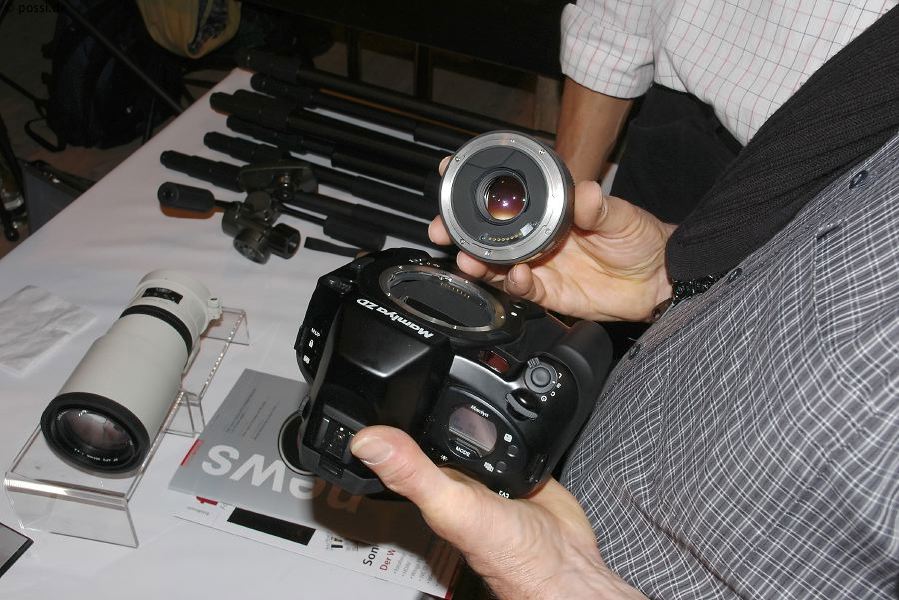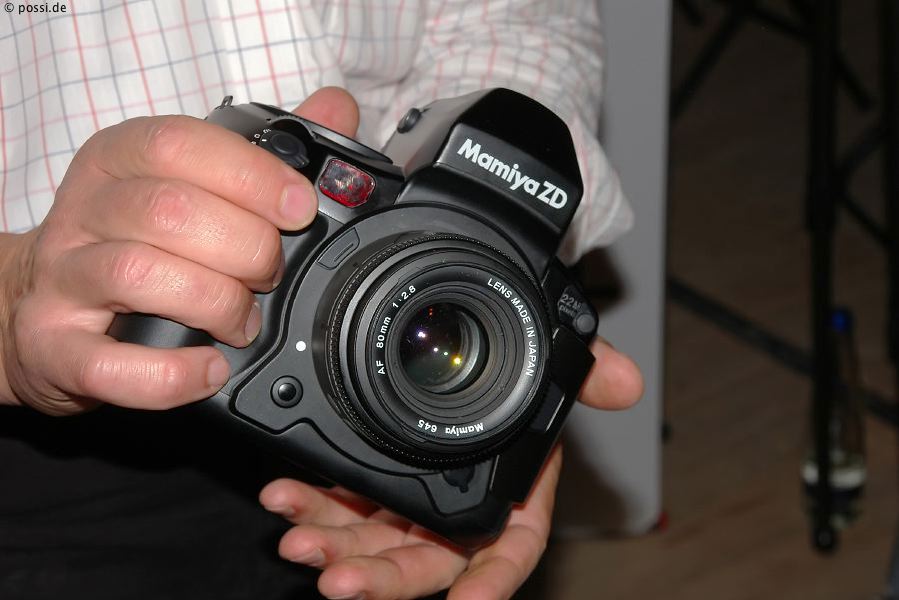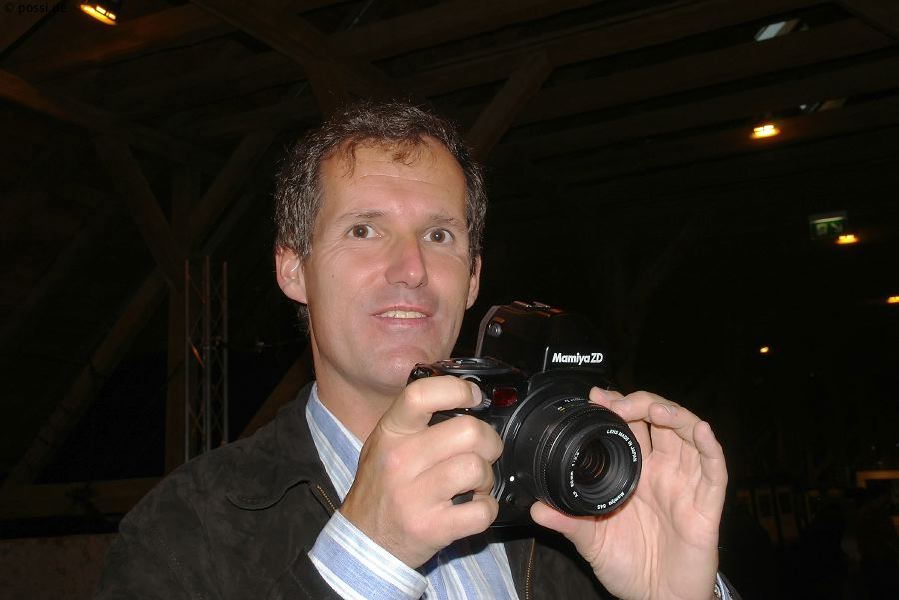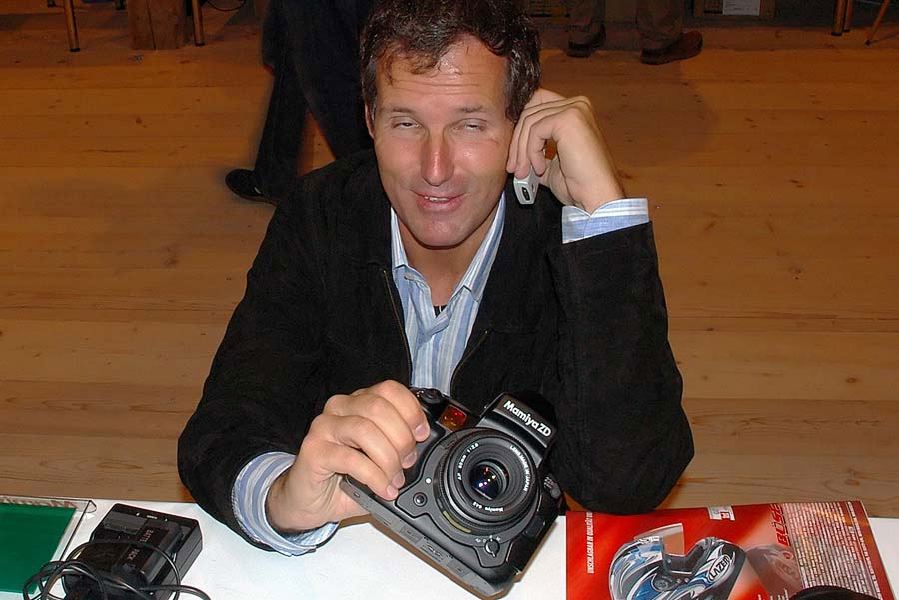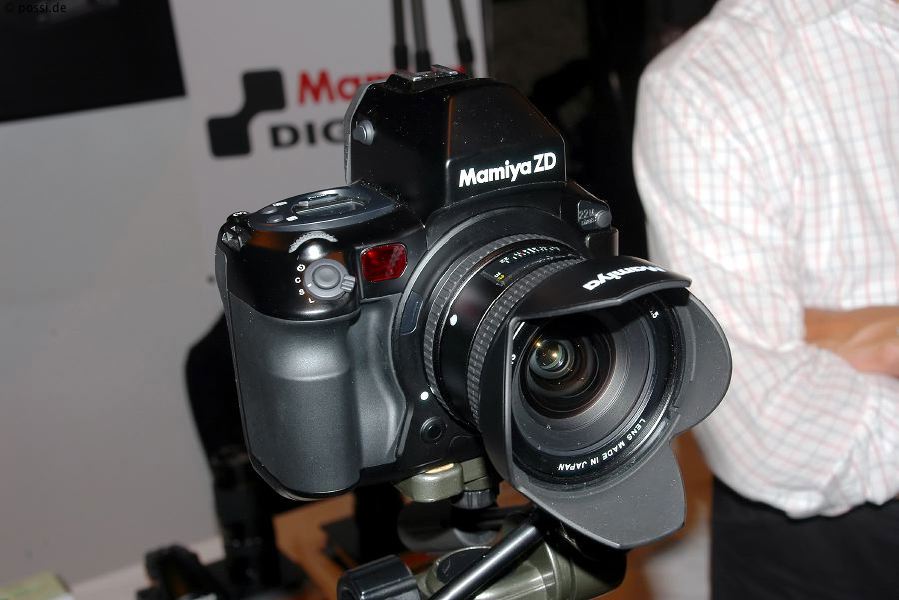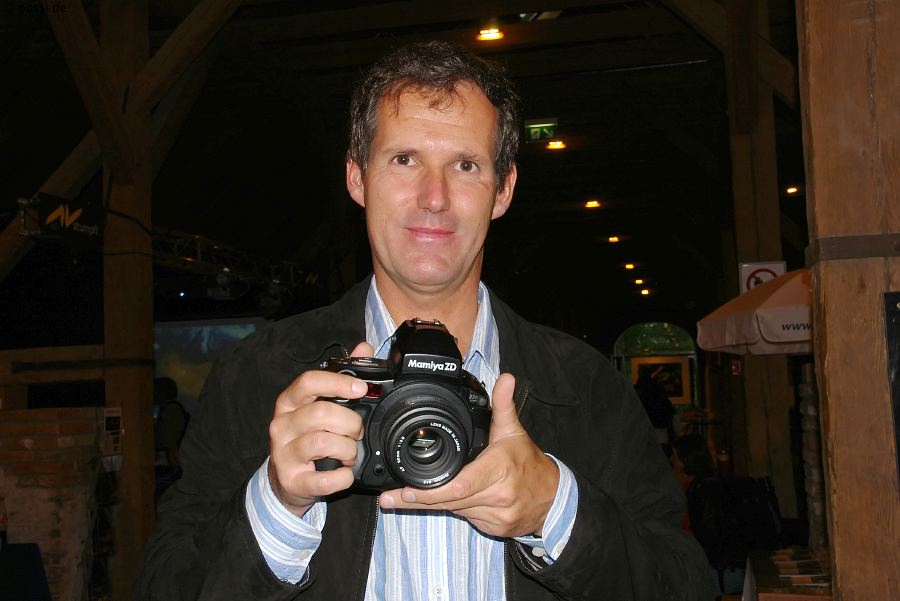
On the occasion of the Fürstenfeldbruck Nature Photography Days I had the opportunity to try a pre-production model of the Mamiya ZD (as of early June 2005) for a while. Many thanks to the team at Mamiya in Munich who patiently answered all my questions. This camera is the first fully integrated digital medium-format camera – not merely a digital back bolted on afterwards.
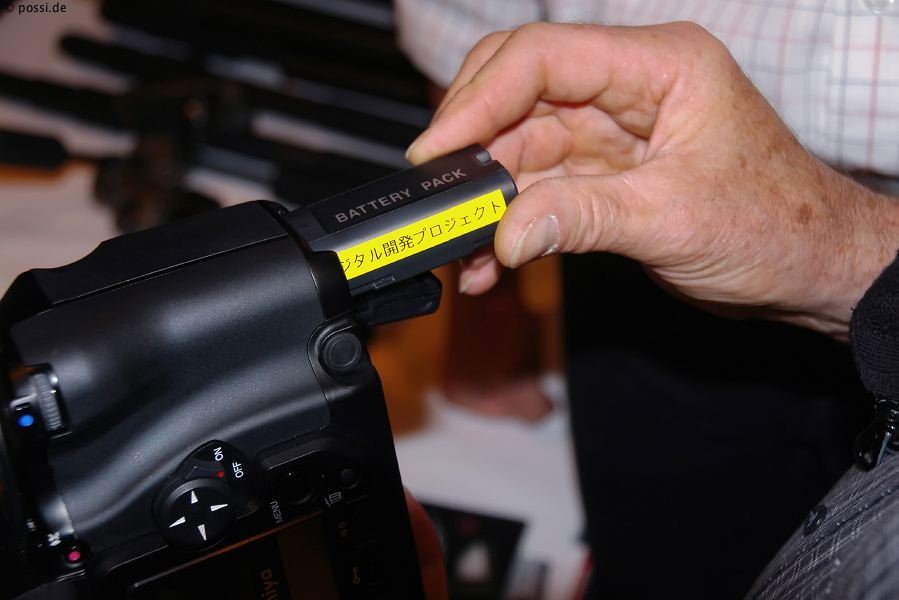
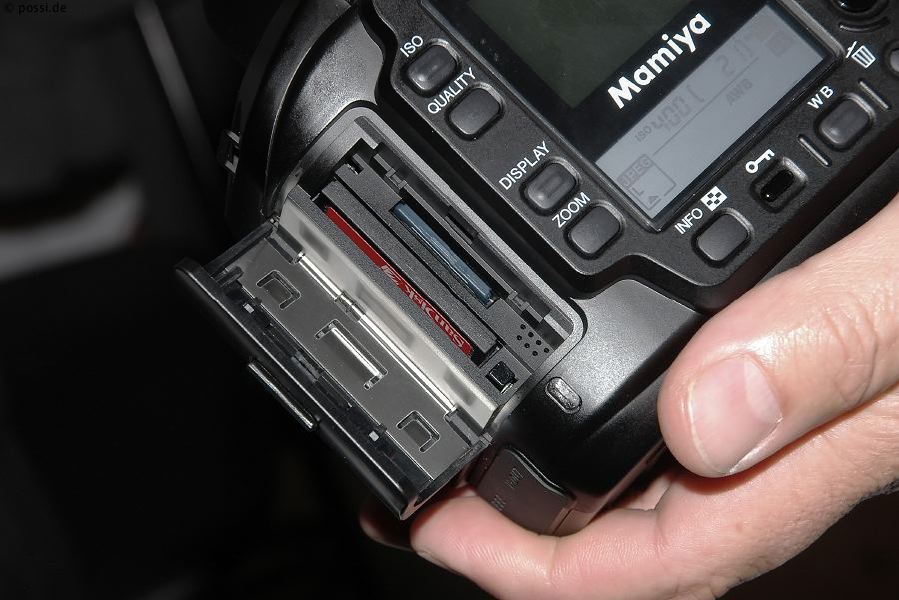
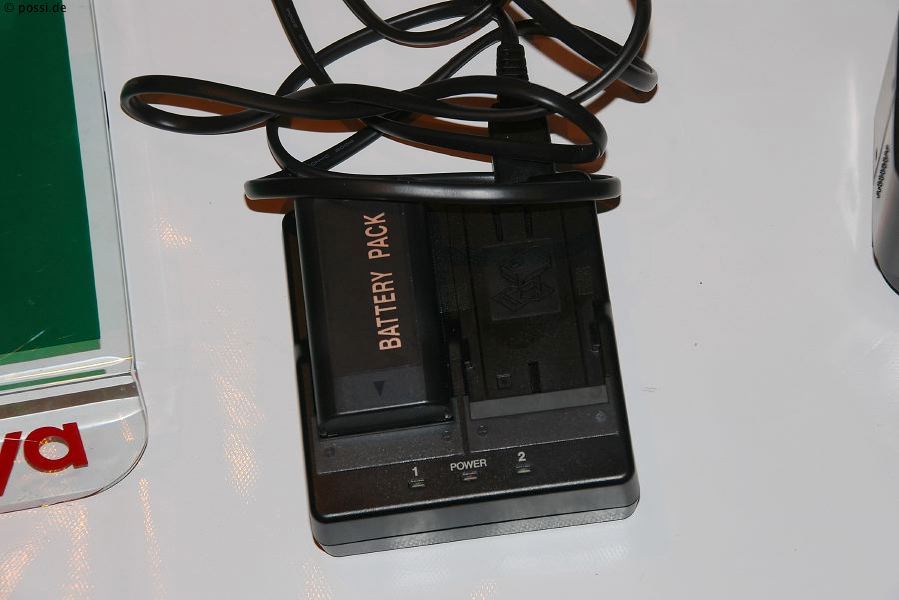
Apart from a few details, the device already corresponds to the planned production version and is fully functional in principle. The handling, the "feel", is quite good; the large body sits solidly in my relatively large hands. The weight differs from the Canon 1Ds MkII by only a few grams, and dimensionally the Mamiya is actually slightly narrower – remarkable given that the sensor, mirror, and prism are in principle twice as large. On the left side is the compartment for the two memory cards, which can remain in their slots simultaneously. Via the menu you can select where data is written. In the base, beneath the moulded handgrip, is a hinged door with a slider for the Li-Ion battery – this appears to be a Sony video battery available everywhere. I could not verify it, but the battery is said to last for 450 exposures, which is surprisingly economical for such a solid device. Supplied with a dual-bay charger.
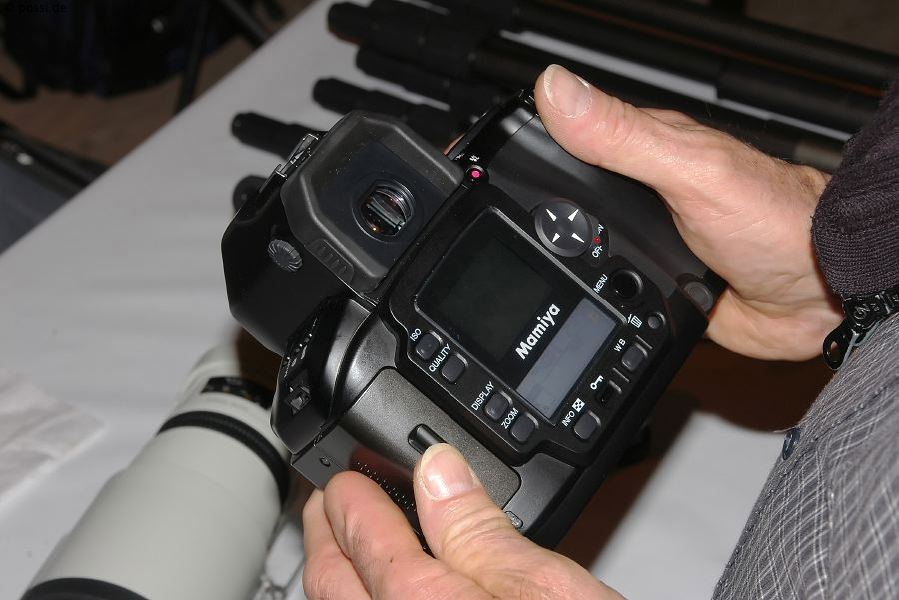
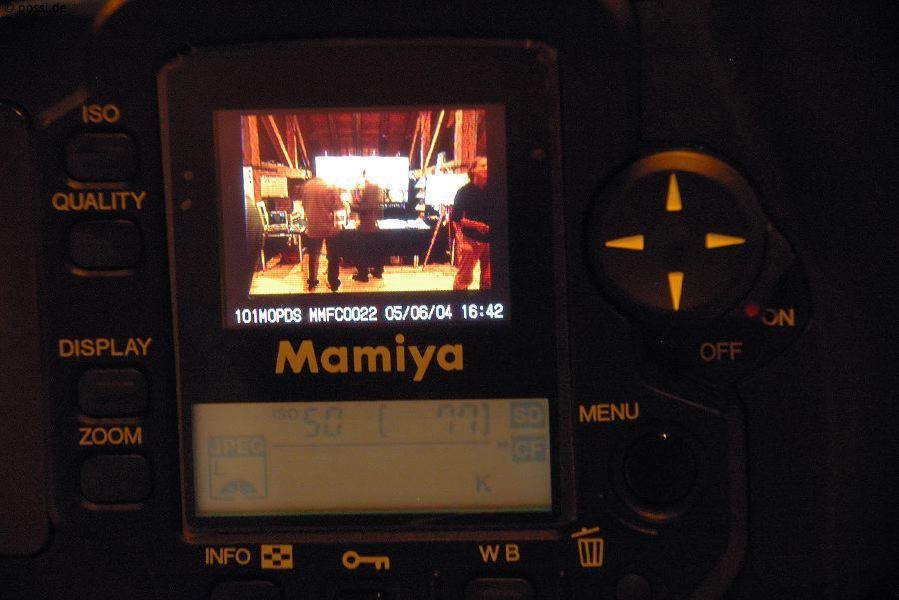
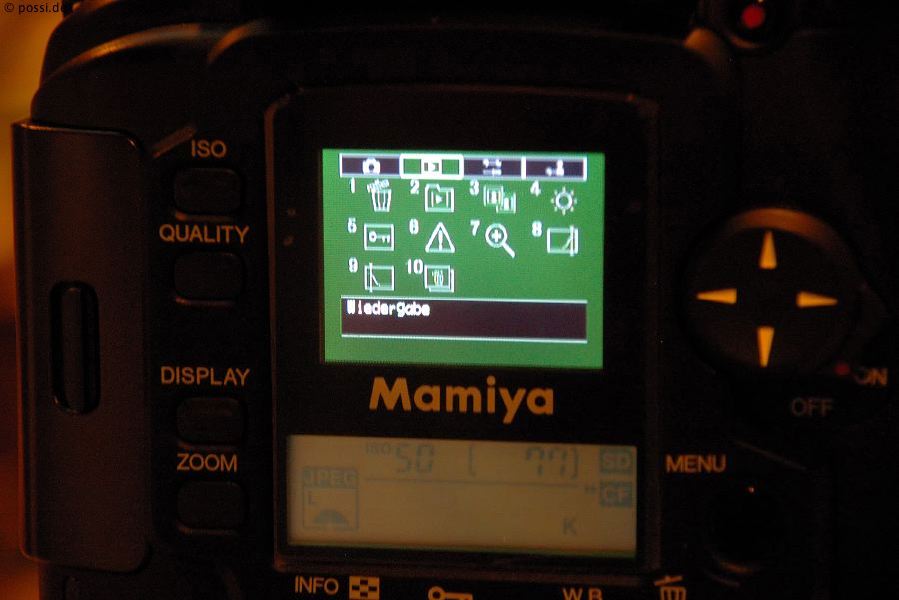
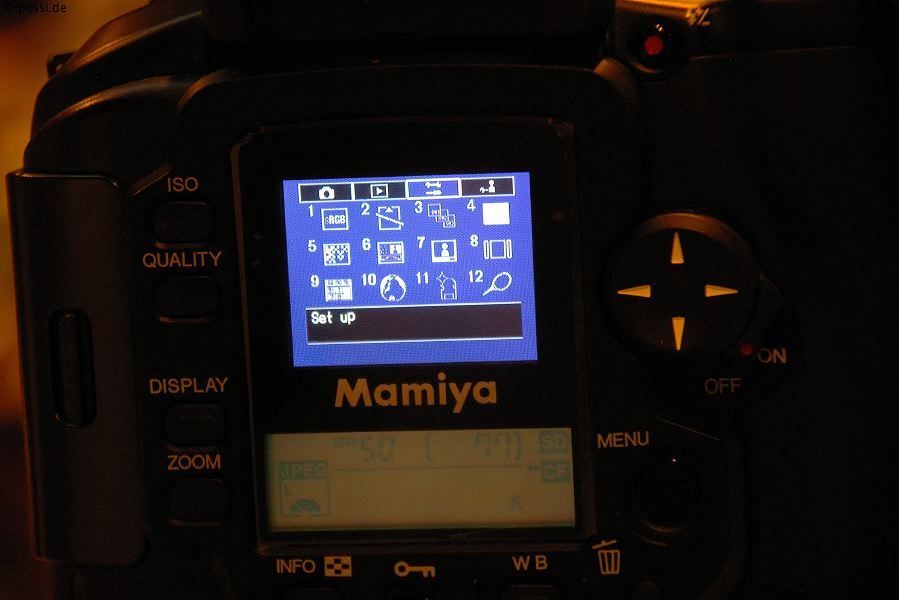
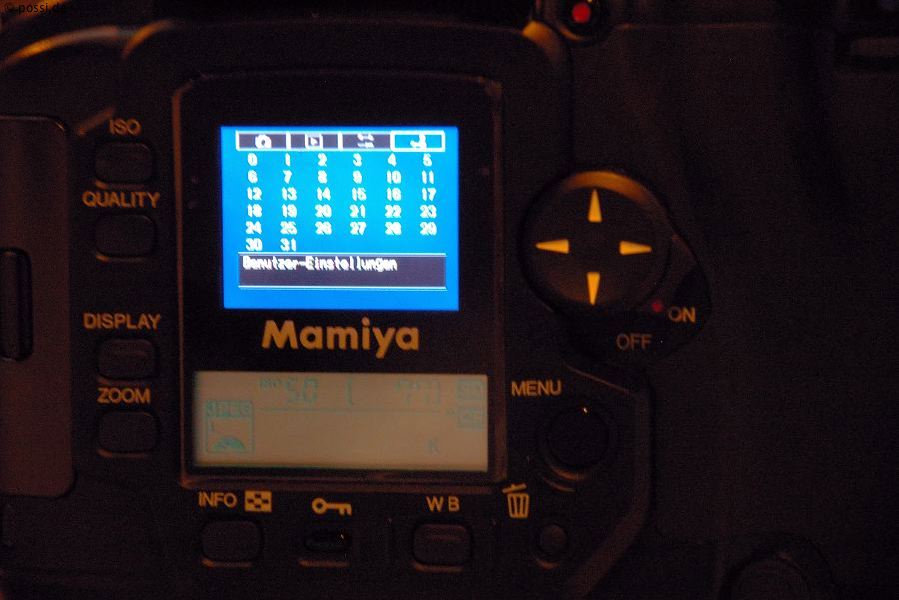
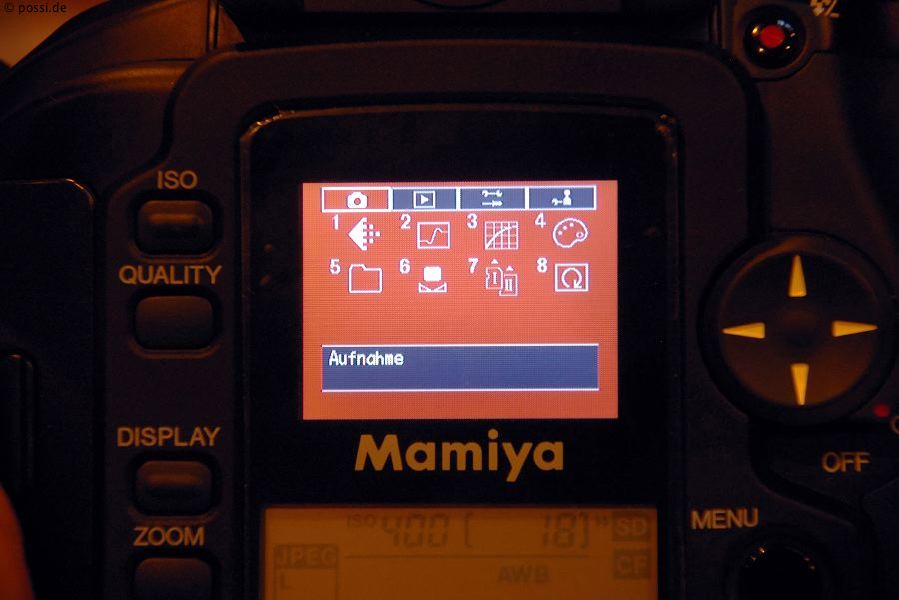
The viewfinder is better than most 35mm DSLRs, though not quite as fantastically bright as the in-house Mamiya 645 AFD. Under the focusing screen the usual displays are arranged clearly. An effective dioptre correction is built in. The two LCD panels on top and rear can be backlit in blue-green and are therefore excellently legible in the dark. They show the usual data (image size, format, compression, frame number, ISO, selected card, white balance, etc.). The menu appears on the 1.8-inch colour monitor, which is adequately bright, somewhat coarse-pixelled by today's standards but power-efficient. The menu is structured into four colour-coded, clearly arranged sub-menus; even the pre-production model already offered a choice of language. The setting options are extensive and well organised. 31 presets can be created and saved separately. Particularly elegant is the data entry using the two scroll wheels; notably, even in programme mode the very practical shift function is available, letting you quickly scroll through the appropriate aperture/shutter-speed pairs.
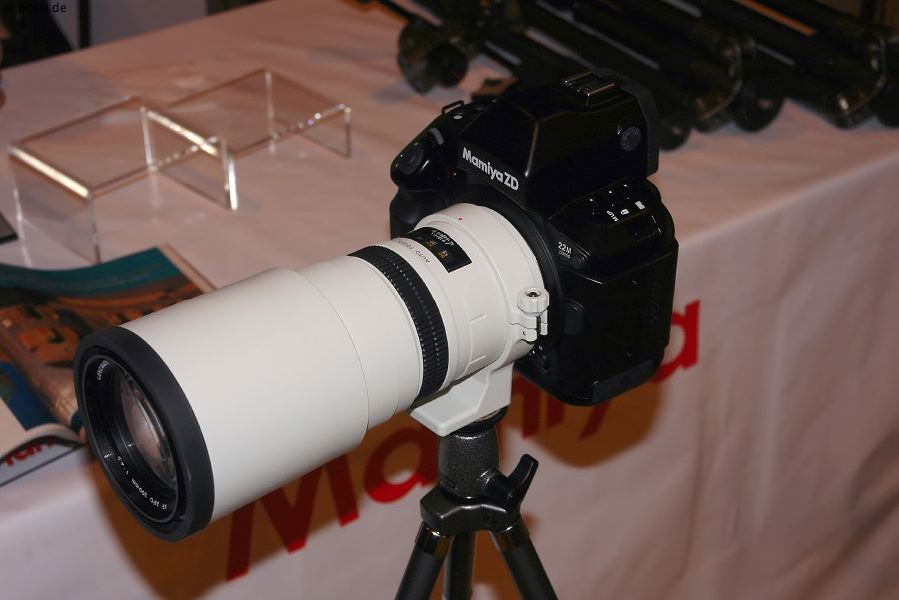
Inside the camera a 36×48 mm chip by Canadian specialist Dalsa is used. The individual pixels are square and 9 micrometres in size. The sensor diagonal is therefore, by Pythagoras, 60 mm; the 645 film format has 56×41.5 mm (diagonal 69.7 mm), giving a crop factor of 1.16×. This calculation is valid only if the active sensor area truly corresponds to Dalsa's specifications (edge areas of sensors are often unused). The currently shortest lens, the Mamiya AF 35mm/3.5, would thus give approximately the field of view of a 24mm lens on 35mm film. Mamiya is considering releasing an AF 28mm later, which would correspond to roughly 19mm in 35mm equivalent – very much in line with my photographic habits. All existing autofocus lenses for the Mamiya 645AF/645AFD are also usable on the ZD. Focusing is adequately fast (noticeably faster than on the AFD); only the 300mm was slower, probably a firmware issue with the pre-production ZD. After focusing (half-pressed shutter), the release is practically instantaneous. Saving the enormous files takes some time: depending on format, approximately 6–8 seconds. The built-in buffer holds 11 images, for which the pre-production ZD needed about 16 seconds – a remarkable 1.4 frames per second for medium format. On roll film you would now already be changing film.
Interestingly, the camera does without a low-pass (AA) filter. Instead, an IR-cut filter is fitted which can be removed. An optionally available LP filter for subjects with regular fine structures can be inserted by the user to prevent moiré. I find this an excellent solution: LP filters soften "normal" images and are completely superfluous for shots of people or landscapes – yet they are permanently built into every DSLR I know of. FireWire is available as a connection interface (fastest and most professional), plus a video output (PAL or NTSC selectable in the menu). Of course you can also remove the memory card and read it in a computer without proprietary software – most users probably do. Camera functions can reportedly be fully remote-controlled from Mac or Windows software, an interesting solution for studio or scientific use.
The images are already remarkably good in principle; the extraordinary sharpness of Mamiya's medium-format lenses is beyond question. This is the clear system advantage over 35mm DSLRs, even full-frame ones. Dalsa's sensor resolution is an astonishing 5328×4000 pixels; at best JPEG quality the 64 MB of uncompressed image data becomes about 10 MB, in the proprietary MEF format 34.9 MB. It's a pity that even Mamiya, as a small manufacturer, is unwilling to benefit from the advantages of an open RAW standard – perhaps they will reconsider. The advantage of OpenRaw or alternatively Adobe DNG is primarily that standard image-editing software (Adobe Photoshop, GIMP, etc.) already has excellent OpenRaw converters built in; moreover the camera manufacturer also benefits from the many shareware and freeware developers who often have enormously creative ideas and create additional software for users. Mamiya offers the ZD sensitivities from ISO 50 to 400. The large sensor chips appear susceptible to colour noise, but modern de-noising algorithms (e.g. Noise Ninja, etc.) allow images to be easily "cleaned". I would therefore find an ISO 800 and 1600 mode additionally interesting (but please without internal smoothing algorithms that calculate the image "noise-free" as Canon does). According to Mamiya, data is processed internally at 14 bits per colour channel and then back-calculated to 12 bits. Here too I would find it worth considering providing the data unprocessed in OpenRaw at full bit depth.
As a nice feature I would welcome the ability for the user to update the dead-pixel mask. On such a large chip area, defective pixels naturally accumulate over time. A user-initiated "black frame" exposure could serve as a renewable mask to identify new hot pixels and replace them from now on with averages of neighbouring pixels. This could perhaps still be integrated into the software – you would always have a pixel-error-free image, a unique selling point over competing products. Also useful would be a "mirror pre-release combined with short self-timer" function to suppress mirror shake. I greatly appreciate this feature on my current camera for quick, inconspicuous, or covert shots in low light with the camera rested – for instance at sacred sites. When you press the shutter the mirror flips up first; then after 2 seconds the vibrations have settled and the exposure occurs immediately – this also saves fiddling with a cable release in such situations.
The price would probably be around €10,000 plus VAT – exact figures are unavailable. A significantly higher price seems unrealistic to me given the competitive situation, bearing in mind the gap to a 35mm full-frame camera on one side and to established back solutions for existing analogue medium-format equipment on the other. Serial production could start in summer; the built pre-production units are in use with selected Japanese photographers to optimise the product. I hope the project is realised (it looks that way), even though Mamiya appears to make more money from other product lines (banknote and chip-card readers for gaming and cash machines). The brand has an outstanding reputation among serious photographers worldwide – it would be a shame if the ZD did not come. Without this product, Mamiya's camera division with its long tradition has no future.
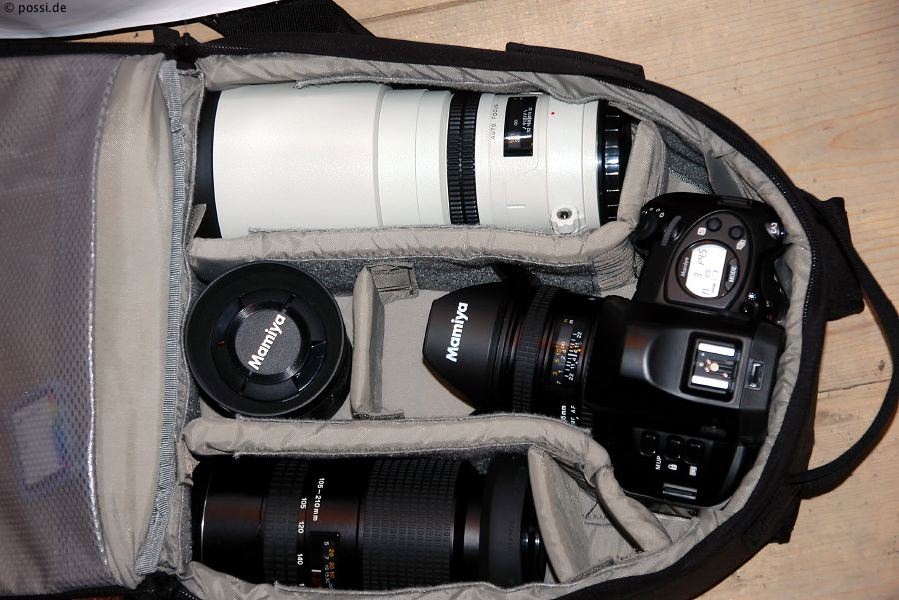
As sensor technology improves, the system can continue to grow, whereas 35mm DSLRs are already approaching the quality limits of their lenses format-wise, as independent tests and personal experience repeatedly confirm. There is thus ample room for a future Mamiya ZD MkII with a 40-megapixel sensor and numerous other developments in perhaps 2–3 years' time. Who should build it if not Mamiya? Pentax is not even halfway there, having presented only a wooden mock-up for a digital medium-format camera with an 18-megapixel Kodak sensor. There are no other medium-format manufacturers, or not anymore; Hasselblad also buys its back from outside; the others make only backs, not cameras. I would buy the ZD immediately. It is ideal for those who want the best possible digital image quality – for travel or in the studio. It has the 4:3 aspect ratio preferred in professional work, which makes image composition much easier than the 3:2 of 35mm film. Everything else in digital photography at the highest quality level is also possible. Only for extremely fast sports is the camera not optimal. The concept is sound; handling is straightforward even in the field (110 RAW images or 500 best JPEGs fit on a 4 GB card); and the available lenses (currently 35–300mm including 2 zooms and a macro) are first-class. The first photo below shows a mini backpack with the ZD and a focal-length range of 35–300mm. At just under 5 kg the whole system is also highly travel-worthy. We look forward to the final product, which stands so refreshingly apart from the prevailing DSLR uniformity – well done, Mamiya!