From: Claus Possberg
To: Joachim Feucht
Subject: Possi's Motorcycle Shipping FAQ
Date: 06 Feb 95 14:14:48
Area: MOTORRAD.GER
On 06 Feb 95 Joachim Feucht wrote to Claus Possberg:
Claus:
America is wonderful, everyone should go (best of all with your own bike – flying it over is surprisingly affordable!).
Joachim:
That reminds me: a mate of mine was asking about it recently. He wants to go to the USA in summer and take his bike, but has absolutely no idea (nor do I) how to go about it. Are there specialist freight agents? How do you make sure the bike arrives on time? How do you pack it? Etc.
Maybe you have a few tips handy – you could even turn it into an FAQ for the echo …
Possi's Motorcycle Shipping FAQ (telegram style)
- Check the destination country – a very expensive "Carnet de Passage" is often required. In India the bank security deposit is around DM 20,000 (I managed a special arrangement with my bank). If the bike goes missing, the money is gone. The ADAC provides information on the amounts required and also arranges Carnets (cost approx. DM 200). Deposit amounts are typically DM 2,000–4,000.
- Check customs procedures (call the embassy).
- The problem in many developing countries is slow clearance, particularly for sea freight. You have to find your motorcycle in the port first, and most large seaports are enormous and marked "no access". It is sensible to engage a local freight agent (I did this in Bangkok and Bombay – costs money, usually DM 200–300, but worth it). Addresses are also available from large international freight companies. I have had quite good experiences with "Union Transport"; Schenker in Munich was not especially helpful and extremely expensive. Doing it yourself requires strong nerves – you must stay very cooooooool.
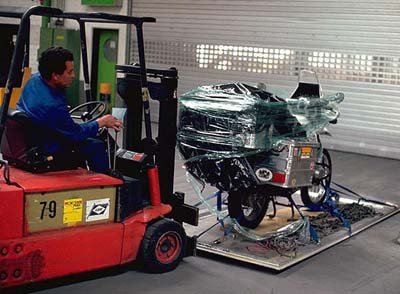
- Air freight: costs more, but has important advantages: clearance is far faster, as air freight facilities are not set up for storage. Sharing the same flight is even more expensive, but simpler – you collect the bike the next day at the latest. Disconnect the battery, drain the tank (I always left the reserve in). Some airlines provide special pallets; with 4–6 long (3-metre) straps the bike is easily secured. Otherwise the original cardboard box is the most space-efficient option, but the front wheel and handlebars must be removed. However, these boxes are designed for container transport and are often unstable (cardboard on a wood/metal frame). Harley and BMW boxes are good; Honda is acceptable (at least up to 1991). Reinforce if necessary or build something better. A forklift once speared my cardboard box sideways – fortunately only a few spokes were bent, which I had with me. If you see the shattered crates in a Third World sea-freight shed, you will feel sick. They handle cargo there in a way that makes your head spin. At least 50% of such incidents are total losses – well, a 20-metre crane … Sea freight is charged by volumetric weight; for a motorcycle the volume always dominates because it is relatively light for its size. In air freight the weight and the width of the pallet also play a role.
- Prices (amounts I actually paid – shop around and negotiate with freight companies!): approx. DM 600 one way to Bombay, sea, original box, XL350; DM 800 to Bangkok (return in a larger locally built box via Singapore approx. DM 1,000). Air freight to Vancouver, Canada west coast: DM 1,249 return(!), a special offer from Wardair because of unused freight capacity – we flew on the same plane. Nowadays specialist motorcycle freight brokers (GS Sportreisen Munich, Bavaria Ltd. travel agency Munich, Fly and Bike Bielefeld) offer a range of destinations, mostly based on Lufthansa and LTU rates – not cheap (long-haul two-way from approx. DM 2,500). Air freight direct is about 30% cheaper. Air France is relatively affordable to Africa, e.g. Kenya in 1990: only DM 900 Mombasa–Paris.
- Destination-country requirements: find out in advance. Australia, for example, requires a fumigation certificate and no untreated timber in the packaging (or only with toxic treatment). Prepare such things carefully. It is absolutely essential to know the business language of the destination country: Spanish in South America (Portuguese for Brazil), generally French for Africa (English in South Africa), English for Southeast Asia, Australia, etc.
- Sometimes the destination freight agent is willing to store the packaging for the duration of the trip if a round trip is planned. It is practical to know your return point in advance. In developing countries it is usually possible inexpensively to have a sturdy crate built locally. My tropical hardwood box(!), which then ran via transhipment in Singapore to Hamburg, cost only DM 80; I still have it in the attic – I certainly won't find anything better here.
- The motorcycle suffers from sea air. Container shipping is preferable where at all possible (or air freight). My Honda, for example, arrived after a 10-week sea voyage quite heavily oxidised despite the sturdy crate. Union collected it by lorry to Munich for only DM 80. Customs clearance in Germany is straightforward if you declare it as a "returning tourist vehicle" and include a precise list of the crate contents – they usually don't rummage through it, so that a local agent can handle clearance.
- Overall, the package shipping deals that now exist are certainly worth considering, as they follow well-trodden paths that save a lot of stress. I didn't have the option back then – such things didn't exist 10 years ago – but today I would use them. Even these can go wrong, as I experienced with a planned container shipment to South Africa in 1995, which I had organised for a 5-week South Africa–Botswana–Namibia trip.
- Some countries simply do not permit entry with motorcycles – for example China (unfortunately!!!), Indonesia, Burma.
- Bribery: in developing countries it is common to demand a bribe ("baksheesh") for important official transactions, otherwise clearance takes weeks. This needs to be handled very subtly. First you have to read the situation correctly, because it is rarely demanded openly (most openly at remote Arabic border posts, where sometimes goods are demanded, e.g. lending a pillion passenger for the night, or at least the shortwave radio …). Then you have to understand the situation – is the person across from you actually important for you, or merely acting important? Otherwise you might end up bribing another 20 officials – word gets around immediately. So: judgement.
- In countries such as the USA, Canada, Australia, etc. everything runs correctly. On the other hand, if you have forgotten a document there, there is no negotiating.
- Documents: national and international, plus copies kept separately. Insurance must be taken out in some countries; in the USA it is even available through Allianz. For Mexico, for example, you can buy the required third-party liability cheaply by the day or week at the border. Otherwise I travel without insurance, as in the middle of nowhere you generally cannot enforce any claims anyway. In Thailand in 1988, for example, killing the wife of a Thai national (a Japanese tourist ran her over in a hire jeep) cost about DM 20,000 (according to the Phuket police station, where I was detained after a traffic accident). Show only international documents where possible – and don't let them be taken away! I always carried 2 passports, but beware: if that is discovered you go straight to jail in several countries!
- Transport insurance for shipments from Germany: take it out – usually only about 1–1.5% of the insured value. The loss rate can be considerably higher, particularly for sea freight!
- Shipping times can be enquired. For distant destinations usually 3–8 weeks. Allow 1–2 weeks more, as ships are often a few days late. But don't allow too much time, as the destination port charges storage fees – between DM 2 and 30 per day.