A few tips on things I am regularly asked about. I am no competition rider — I am far too old for that, and my academic arms would not stand up to it either. All the riding techniques here are based on skills I have acquired through practice. Since I also never had any desire to take an enduro course, I have crashed countless times through incorrect technique. An enduro course — widely available today — certainly helps, and practising on a cross track with a loaded bike is also good training. I have often impressed the motocross riders there with my BMW...
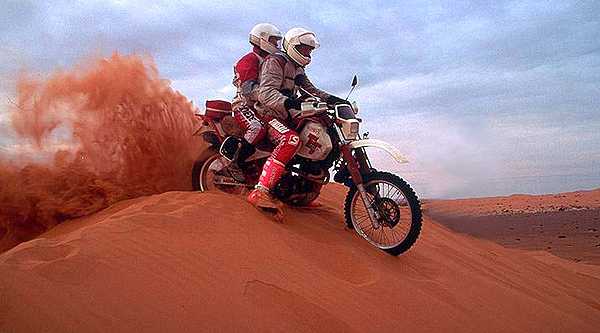
Photo: Even with a pillion you can ride over dunes — as long as she stays still! Libya, near Ghat 1991.
Are there special techniques?
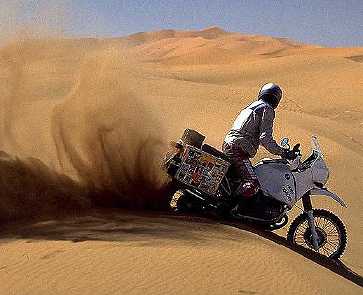
Yes, and it depends on load, machine and riding ability. The most important thing, in my opinion, is to ride the route "in your head" in advance. Others call this "reading" the track. If you have exactly the right speed you can steer around every large stone instead of exhaustingly "bumbling over it". You can already create the exact line in your head; the body together with the motorcycle then follows it, while ahead in your mind the next line is constantly being planned. In this way you can also take advantage of every natural berm. Conversely, it is completely wrong to look directly in front of the front wheel — you will not find any proper line, you become too slow at difficult spots and eventually start to wobble. Photo: with luggage over sand in southern Morocco.Which enduro is suitable?
This is almost a philosophical question. I would rule out all machines that are either unreliable or complicated, too heavy (over 200 kg; with a low centre of gravity possibly 10% more for a Boxer — this is a kind of magic threshold), have fairings, or do not have suitable long-travel suspension (like the Transalp). That leaves only a few: the single-cylinder enduros from Yamaha, Honda, Suzuki and KTM, the BMW BIG (good suspension but heavy and high centre of gravity!), the BMW R80/100GS series and the Honda Africa Twin (superb machine, but with fairing; earlier models had trouble with air filter in sand). I never rode the new Kawasaki single, and the DR650 is easy to ride but has a vague, unstable chassis (the '96 DR is said to be much better). I consider both the new BMW enduro and the Tiger and Super Ténéré unsuitable because they are too complex and too heavy. They are fantastic on-road touring machines. For really serious use, sport enduros (but not competition machines — far too unreliable and maintenance-intensive) like the LC4, TT and XR are the most suitable, though heavy loading must then be strictly avoided.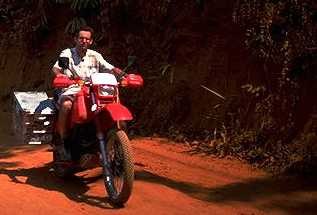
What engine size?
Riders with little experience will certainly manage best off-road with a sporty 350 cc or 400 cc four-stroke enduro — they will be considerably faster than on a 650 cc or a touring machine. At low revs the engine is simply much easier to control. You cannot carry much luggage, but the off-road fun is doubled. And the low fuel consumption guarantees a very good range with a larger tank. That said, a long motorway approach on such a machine is torture. Riders with a trailer are lucky here. The 600/650 cc riders are not much better off, only the twin-cylinder riders are comfortable. On the other hand, particularly the large twins require a considerable amount of riding experience to be moved briskly and safely over open terrain. In my experience a beginner riding a 350 after 2 days will outride an already somewhat experienced pilot on his heavy enduro. Photo: in the jungle with my XL350 at Mae Hon Son, near the Burmese border in northern Thailand.What is desert terrain like?
90% of it is totally easy to ride. The tracks are stony or gravelly, often slightly sandy. Deeper sandy sections cause problems. Very rare is terrain where rocks are scattered in deep sand — particularly unpleasant to ride because you cannot just open the throttle and go straight. Every beginner has trouble with sandy ruts; they are common on purely sandy tracks. It is worse when these ruts are very soft and deep (50 cm depth does occur, so that the "ears" of a Boxer engine scrape the ground!). Free off-road riding (without a track) has the advantage of no ruts disturbing you — it is more fun. But even the wildest tour inevitably passes over some kind of track.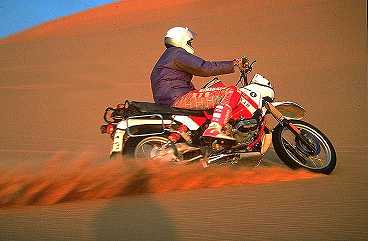
How do I ride through deep sand?
Let the tyre pressure down to 0.9 bar, front and rear. Less is risky: the tyre casing can rotate against the rim — at the front when braking, at the rear when accelerating — which tears off the inner tube valve. If you screw the valve lock-nut against the cap rather than against the rim, a valve sticking out at an angle gives advance warning (useful to me with 0.7 bar in the front tyre). Then immediately release more air, push the tyre into the bead seat (the wheel does not need to be removed), straighten the valve and pump up. For deep sand otherwise there is only one thing: throttle or get stuck. If the revs drop, instantly change down and give full throttle. When starting on uneven deep sand, always only downhill. Turn the motorcycle round for this, even if it costs sweat. Therefore never stop on an uphill slope! Never spin the rear wheel — it just means more digging out afterwards. For starting in extremely soft spots I use the following technique: lean far forward, chest over the handlebars, and lightly rock the footrests to reduce weight. As soon as the tyre finds grip, shift to second gear and give more throttle. With powerful machines (my HPN, for example) you can also try pulling away directly in second. Photo: in the great eastern Erg, Algeria, Christmas 1991.Questions, criticism or suggestions for additions to this page? Write to me! I can always use input. If you have an interesting FAQ, send it to me!