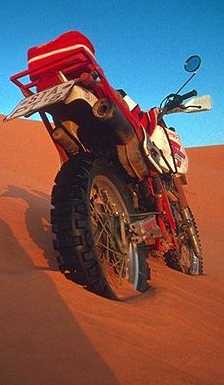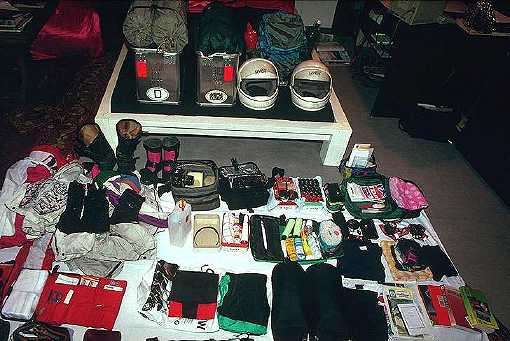
The photo shows everything I brought on my 6-week trip to Australia for two people. It all fitted without problem in and on two aluminium panniers and an enduro tank bag. We then simply checked the panniers and tank bag in as regular luggage on the plane.
The most important tip: carry no ballast!
A maximum of 15 kilos is acceptable; 20 kilos is the absolute pain threshold. As obvious as it sounds, most riding problems are caused by luggage.Here is how I handled it on my Morocco trip: I took just under 17 kilos of "essential luggage" — which was actually already quite comprehensive, organised so that I could manage technically on my own even without my travel companion. A full camping kit is included (without table and chairs, of course), so my partner could save weight there — coordinate in advance! This kit should be sufficient for anyone.
My luggage (Morocco trip example) consists mainly of:
- Tent NorthFace Tadpole (1,991 g), incl. groundsheet (387 g), 4 plastic sand pegs (150 g): 2.5 kg
- Sleeping bag NorthFace BlackKazoo (1,118 g): 1.1 kg
- Sleeping mat RidgeRest in pouch (355 g): 0.3 kg
- First aid, nail kit: 0.6 kg
- Wire lock (2 m stainless-steel wire with 2 loops from a sailmaker, for securing jackets, helmets etc. against quick theft): 0.3 kg
- Small towel: 0.1 kg
- Roll of Hakle 1000 toilet paper in old tent pouch: 0.4 kg
- 3 maps, map case, 3 travel guides, green bag: 1.8 kg (you can save here if you read fewer guides)
- 2 water bottles (Markill 1 litre, empty): 0.3 kg
- Russian petrol stove in pouch: 0.9 kg (lighter ones exist, but this has been the most reliable)
- Spare visor: 0.1 kg
- Petzl Mini headlamp, A6 notebook (for evening reading and notes): 0.2 kg
- Document wallet with purse (normally in the camera bag): 0.5 kg
- Food bag (incl. knife, fork, spoon, Swiss army knife, spices, lighter, tin mug, Micropur, bungee cord, velcro for pannier lid, valve rings, fire paste, Tadpole repair sleeve): 0.9 kg
- Wash bag (wet razor, hairbrush, toothbrush, 200 ml shampoo, Tempo pocket tissues, deodorant (plastic), spare glasses, sunglasses, mini sewing kit, 2 small + 2 medium plastic straps): 1.1 kg
- Underwear bag (2 silk undershirts, mesh undershirt, fleece shirt, 2 undershorts, 1 pair socks, long ski undergarments — in cold weather wear everything in layers): 0.7 kg
- Cold-weather reserve: rain suit, Motodress split 0.8 kg; down waistcoat in pouch 0.4 kg; fleece jacket in pouch 0.6 kg
- Other clothing: leather gloves second pair summer 0.2 kg; light thin foldable summer shoes 0.6 kg; jeans 0.9 kg
- Spare-parts pouch for my BMW (stainless screws, nuts, washers in various sizes, drain plugs, drum brake sleeve, spark plug, mini jump leads, puncture repair kit, tyre sealant 200 ml, pump, photocopies of carburettor, electrics, dealer list, stainless endless strap, wire thick/thin, duct tape wide/narrow, insulating tape, Uhu, cyanoacrylate glue, Praktikus aluminium sealant, tyre valve, cap with integrated valve remover, universal nipple set, cable ties, wire, test leads, fuses, terminal blocks, spare bulbs, clutch/gear lever incl. mount, carb needle valve, 2 old fork seals, used clutch cable): 2.6 kg
- Garmin GPS incl. batteries: 0.3 kg Carrying much food is not worth it: you can eat cheaply at any roadside stand, and visiting local markets is always an enjoyable part of the trip. I bring at most a few better-quality instant soups and pasta dishes.
In addition comes my photography equipment as a hobby (those who do not always haul this heavy stuff have it much easier!):
- Tamrac camera bag approx. 20×15×15 cm, containing:
- Three camera bodies, LX and Super A and ME super (up to 15-year-old Pentax gear)
- Small system flash with GN 20
- Fixed focal-length lenses: 15 mm fisheye, 20 mm, 35 mm, 50 mm, 85 mm, 200 mm
- No zooms — they always break on rough track riding!
- Polarising filter, close-up lens, spare button cells, 4 AA cells
- Bag with extra films and batteries (26× 50 ASA, 16× 200 ASA, 12 AA)
For many tours the stripped-down kit is also sufficient: 1 camera with 50 ASA slide film, lenses 20 mm, 40 mm, 135 mm, polarising filter, close-up lens, spare films.
Tools
I do not count the on-board toolkit as luggage, since it is included as standard with the BMW (slightly improved by me) and calculated in the "vehicle-certificate weight". It sits in a favourable centre-of-gravity position under the seat (Japanese bikes have different spanner sizes!):- Open-ended spanners: 7–8, 10–11, 12–14, 13–17, 19–22
- Ring spanner 10–12
- Sockets 13–19, 21–22 with bar
- Allen keys 3, 4, 5, 6, 8
- Phillips and flat screwdrivers in medium and small, interchangeable
- Needle-nose pliers medium
- Grip pliers small
- Round file small, flat file small
- Special valve gauge (remove unnecessary leaves)
- 2 BMW tyre levers (actually too short, only usable with extension tube and grip pliers as emergency)
- Small carpet knife
- Pocket multimeter (credit-card size, Conrad catalogue)
- Tyre pressure gauge
- 12 V mini soldering iron (with a little solder)
What you wear at the warmest temperatures you can expect obviously does not count as luggage (here for Morocco): undershorts, socks, shirt, Gasgas long-sleeve shirt, Stilmotor cross armour, Dainese cross jacket with hard elbow protectors (since I wear cross armour underneath, shoulder protectors removed), Sinisalo cross trousers with hard knee protectors, Alpinstars trial boots, Sinisalo cross gloves, Uvex Quattro silver helmet (all items and brands are of course just examples; my gear has proven itself and can be recommended).
On the subject of luggage storage
I have a separate page about this: Luggage systems.