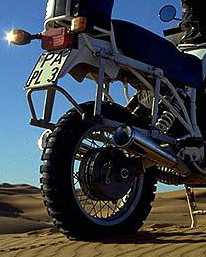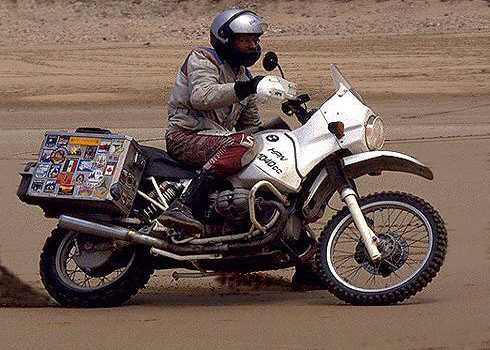
Still riding off-road sportily with luggage
General notes on weight and weight distribution:
The most important tip is: carry no ballast! 15 kilos is acceptable; 20 kilos is the absolute pain threshold. In the photo above there was actually much more — 41.7 kilos (including water, aluminium cases and carrier) — but nobody should try to emulate that. An inexperienced rider will not get through the sand with that! As obvious as it sounds, most riding problems are caused by luggage. You take far too much, and on top of that it is stored unfavourably. Every good publication on this subject states that the optimum position is in or under the centre of gravity. Unfortunately you cannot put much there, because the engine is already there! Not entirely true — heavy tools needed only rarely (e.g. long tyre levers) can be clamped to the bottom of the frame with band clamps. Rally riders even have a small box at the front bottom of the engine. The second-best place is under the seat — the heaviest spare tools and parts should go there too. Then comes the (small) tank bag. If I take a tank bag at all, my camera gear goes there. Only after that come the side panniers, then the space behind the seat (unfavourable weight distribution), then the luggage carrier/top case (really bad!). A bike with 10 kg in a top case handles worse than with 20 kg in side panniers, especially off-road where every gram counts!Luggage storage in practice:
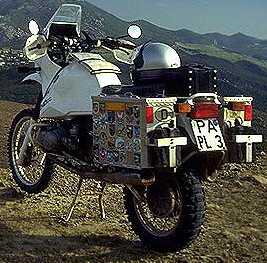
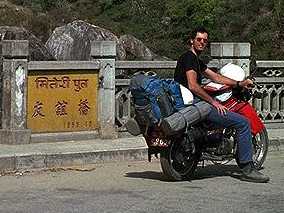 The photo shows me — photographed by my pillion — in Tibet during my Nepal trip in 1991. There I had a rucksack and bags (because of trekking). That is quite impractical on a motorcycle. It is also possible to manage without loading the pillion seat or even the luggage rack. In Morocco as on many other tours I kept everything in the panniers and under the seat — no floppy stuff-sacks in addition. Doing long-distance travel with a pillion is serious work! However, my aluminium panniers are quite roomy and easy to load from the top. The tent poles of my NorthFace Tadpole just about fit in, so I always had the complete camping equipment (including the sleeping mat!) in the panniers. This is an immense advantage — they are fairly theft-proof. Park the bike, lock it, walk away. No problem as with tank bags, stuff-sacks, etc. The disadvantage of panniers is their weight and the potential injury risk in a crash. The real alternative is soft bags and pouches from Ortlieb, which are now copied by other manufacturers. It is much better to use 2–3 small ones (sizes S and M) rather than one giant "bin-bag". Of course this is much less convenient than panniers and requires strict limitation to the absolute essentials, but it is then the lightest solution in combination with a tank bag. For example, I spent a week in the Pyrenees in February 1995 with very little gear (no camping) — wonderful snow-free winter that year; we were the only enduro riders there! This way you can also ride extremely sportily.
Luggage panniers:
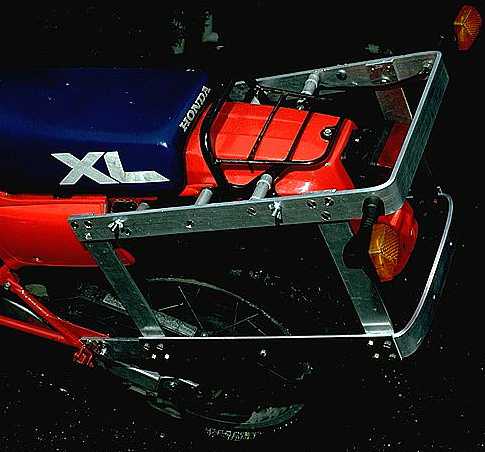
Riders keeping under 20 kg can possibly manage even with original plastic panniers (BMW and Yamaha are good; I do not know the others) or good aftermarket cases (Hepco-Becker Junior and Givi). The corresponding carriers will just about take the strain if you do not ride too wildly off-road (secure well with straps). The problem, however, is that you have to allow for minor falls, and most plastic panniers shatter in a crash (not the HB Junior plastic case). Good fully-welded aluminium panniers, like those by R. Guhr (see photos), RMS (tel. 09306 8599), will at worst get a dent. Other serviceable panniers are available from Götz/Hechingen or Därr/Munich — not welded and from thinner sheet (I had those on my Australia trip). The heavily advertised Hepco-Becker aluminium pannier, by contrast, is only suitable for the trip to the ice-cream parlour and is also far too expensive. Giancarlo has written an excellent overview of currently available aluminium panniers on his aluminium pannier page. Aluminium cases are naturally bare inside; to avoid getting black aluminium residue everywhere I always line my panniers inside with 2 mm cork sheet (DIY store — beware, many are thicker than 2 mm!). This material is very light, insulates well, is mechanically stable and inexpensive. Good aluminium cases only make sense if a suitably designed carrier is available. Bolting premium cases to a standard carrier designed for plastic panniers is, in my view, pointless (except for show in the car park). A good carrier is available either from the specialist, or you make one yourself — which I have done several times; each time it got better, it does not break but at most flexes slightly.