Motorcycling is more fun together
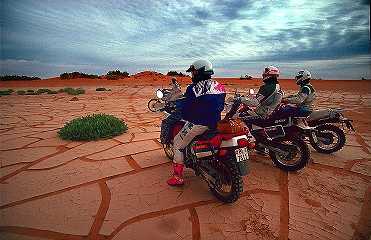
Almost everyone who has ever ridden in a good group will confirm this. For more extreme journeys, travelling with at least one companion is a safety requirement. Riding as a pair is a great solution: you can adapt to each other and only have one other motorcycle to keep an eye on. As soon as there are more than two travel partners, considerably more tolerance and discipline are needed. Photo: four-up on a dry salt flat near Tihemboka, Libya, 1991.
General thoughts on choosing a partner
Formally there are two options: "one person is the boss" or "everyone has a say". The first only really works in motorcycle gangs, whose 1970s spirit has long since evaporated. For a journey it is not suitable in my opinion (except for organised tours). That leaves the second option, even when one partner is far more experienced than the other. When people team up, the group will always have a variety of skills, which you can use very positively to make the trip a success. However, it is unfavourable when partners come together with strongly differing interests and preferences. This applies in particular to such mundane things as pace, wake-up times, choice of accommodation, evenings out, or food. A sports rider and a village-hotel enthusiast are not well matched as partners, to give just a couple of examples. A mixed team of male and female riders can also work well, provided mutual respect is maintained. In my experience it is not always ideal (there are exceptions, of course) when partners have known each other for ages, as there will always be particular expectations or aversions that can sour the atmosphere. Choosing the right partner(s) is already half the battle for a successful tour.
Teamwork in trip preparation:
Normally each person will prepare their own bike and equipment. That is precisely why it is essential to agree and settle things
beforehand: Where do we want to go? What kind of terrain do we want to tackle? How will we sleep and eat? Are we doing something extreme that requires special equipment (e.g. tyres, fuel range)? Only once that is
clearly defined should everyone pack what they need. If you want to ride off-road you
must save weight to the extreme (see my
luggage page). That only makes sense if
everyone saves weight. Otherwise the whole team is always held back by one overloaded machine that ultimately makes the planned off-road sections impossible.
Riding together
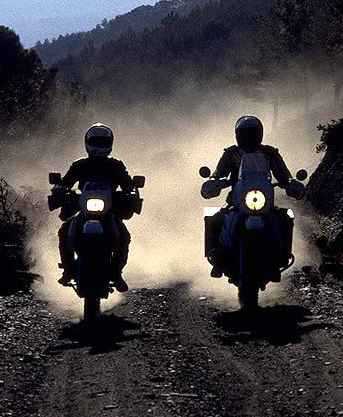
The following riding technique has proved optimal: ride staggered on tarmac, keep distance off-road (because of flying stones and dust). Each rider watches the rider behind in the mirror, slows if that rider falls back, and stops if they disappear. Then wait a few minutes; if they catch up fine, otherwise everyone rides back. Exception: extremely difficult sections, where the most capable rider goes back first. The riding order is agreed at the start and maintained – overtaking each other is unnecessary. The front position should be taken by someone local or particularly experienced; the rear by the most technically skilled rider. When key sections appear – rivers, dunes, steep scree slopes – stop, confer briefly, and stand ready to help (e.g. pushing, etc.).
Differing expectations
If it becomes clear en route that there are, for example, too great a difference in off-road ability or differing views on camping, you can always agree to ride separate routes and meet up in the evening – or a few days later. Do this before it turns into an argument. The reunion, the exchange of stories about different experiences, and the stress-free time go a long way towards putting things right. It is better anyway for each person to be prepared to manage alone or without part of the group – that sharpens the indispensable sense of tolerance.